
Your very first experience with Love Letter might simply involve somebody asking you if you’re holding a number three, you answering yes and being told that you’re out. This game is great isn’t it! Well actually yes it is, Love Letter is the perfect example of needing to give a game time so that it can demonstrate its’ brilliance to you and it generally doesn’t need much time to do this. There’s a subtle beauty to Love Letter with particular card combinations that present situations regarding the state of play and a realisation of how you can leverage them, which can be difficult to demonstrate during the teach as these things are best emerging naturally during play, which is swift and at times brutal.
Speaking of the teach we should really touch upon that as we’ve not really covered what this game actually is. Well what it is is really very simple, you can be up and playing in minutes, a reason it’s so popular and often slotted in to fill an awkward patch of time at the end of a game session. It is however one of the rare games where the theme almost gets in the way of explaining what you’re trying to do. Thematically there’s this love letter that a number of suitors are trying to get to the princess, each of the suitors is represented on the cards and can with various abilities eliminate others but one of the cards is actually the princess and she can be eliminated as well(?) No the theme has never really made much sense to me and strangely nobody has ever really challenged me on it, they’re just happy to play.
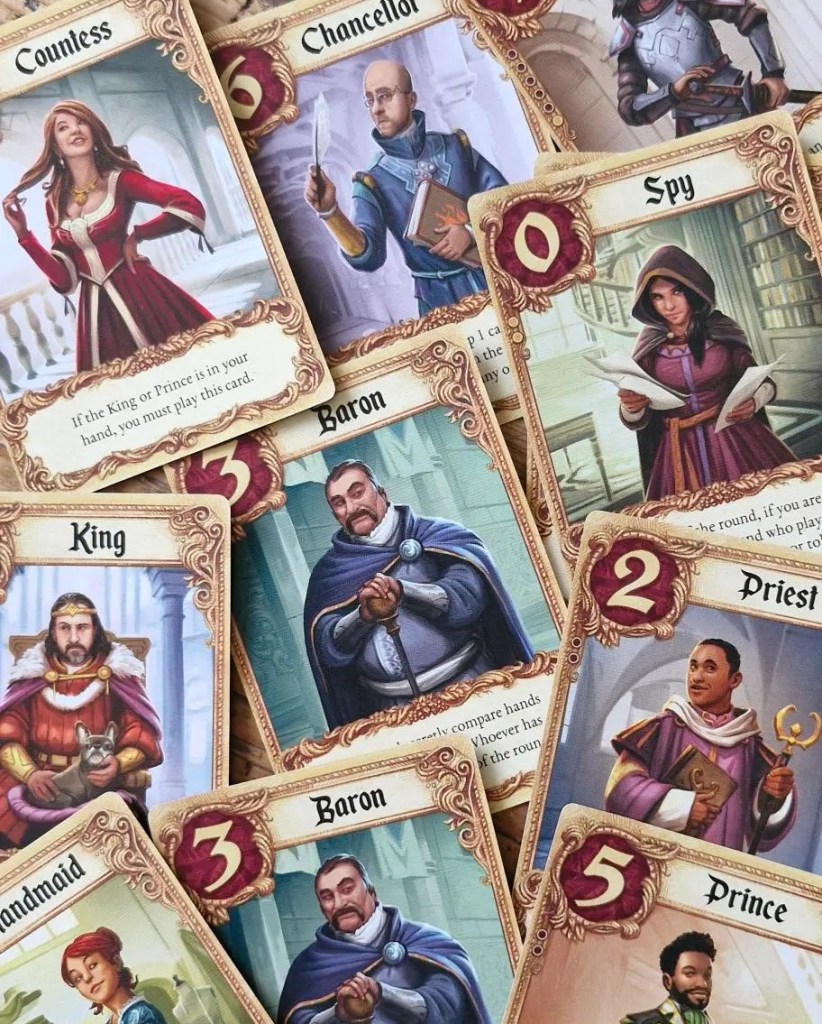
Brushing the theme aside the game comprises of a small deck of cards, a very small deck actually at around eighteen depending on which version you have, that display various characters on them, each one possessing a particular ability and a strength value. You start the round with one card in hand, then on your turn you draw a second card and decide upon one of the two you now possess to play. Place the played card in front of you and follow the instructions on it, simple as that, you start and end your turn with one card in hand. The person at the end of the round with the highest value card left in hand or the only person left in a round after people have been eliminated will score a point and you play first to 3,5,7 or whatever you want.
The abilities on cards are not anything particularly revolutionary, things like being able to see another player’s hand, swapping hands with another player, eliminating another player by correctly guessing their card and various others. Essentially these cards slowly dispense information around the players that facilitate player elimination. I can hear people bemoaning player elimination which yes is something generally avoided by modern games but rounds tend to last a couple of minutes so people aren’t sitting out for too long. Also there can be a real pleasure in the spectator element of Love Letter, following the flow of information between players and knowing who knows what about each other is often great fun to watch.
Judging by what you’ve read here you’ve probably made the assumption that Love Letter is very simplistic, for which you’d be correct. You’re probably also getting the feeling that because of this it’s suitable for new gamers, a quick little gem to tempt people into the hobby. Well, surprisingly I’m going to say that despite this I’m not sure it would work well with a group of non gamers. It is simple to learn, has very few components which means it doesn’t have an overwhelming table presence and is also quick to play, however I feel to get the most out of Love Letter you need to have dived a bit deeper into the hobby to appreciate its’ simple brilliance.
I’m going to make a strange comparison here but I’m going to compare it to The Sex Pistols, stay with me. For people not really into rock and metal or just getting into the genre The Sex Pistols sound like a simplistic raucous noisy novelty with little to appreciate. However, once you explore the history of the rock genre you can see how they did so much with so little and influenced so many with one punchy uncomplicated amazing album. Love Letter does the same, it can invoke the same warm immersive and often amusing moments that games with far more moving parts do but I really feel you need to go forwards in the hobby and then come back to fully appreciate it.
It’s quite difficult to fully describe how Love Letter arrives at these lovely states of play with information flowing around the table but a simple example might go as follows. You play a card to find out what card the person next to you has, as such they now know you know that information. As several cards allow players to eliminate others if they know what someone else is holding, the player to your left needs to escape this situation, so they play a card meaning they can swap their card with the player opposite you.
So the player opposite now knows you know what they’re holding and you’re waiting to pounce and eliminate them but that opposite player also now knows what the player to your left has as they just swapped with them. This creates a new hunter in town and every player knows some information about the other players, maybe not what they’re holding but what they know about someone else. I’m telling you trying to keep up with who knows what after just a few turns can really tricky but it leads to some great moments.
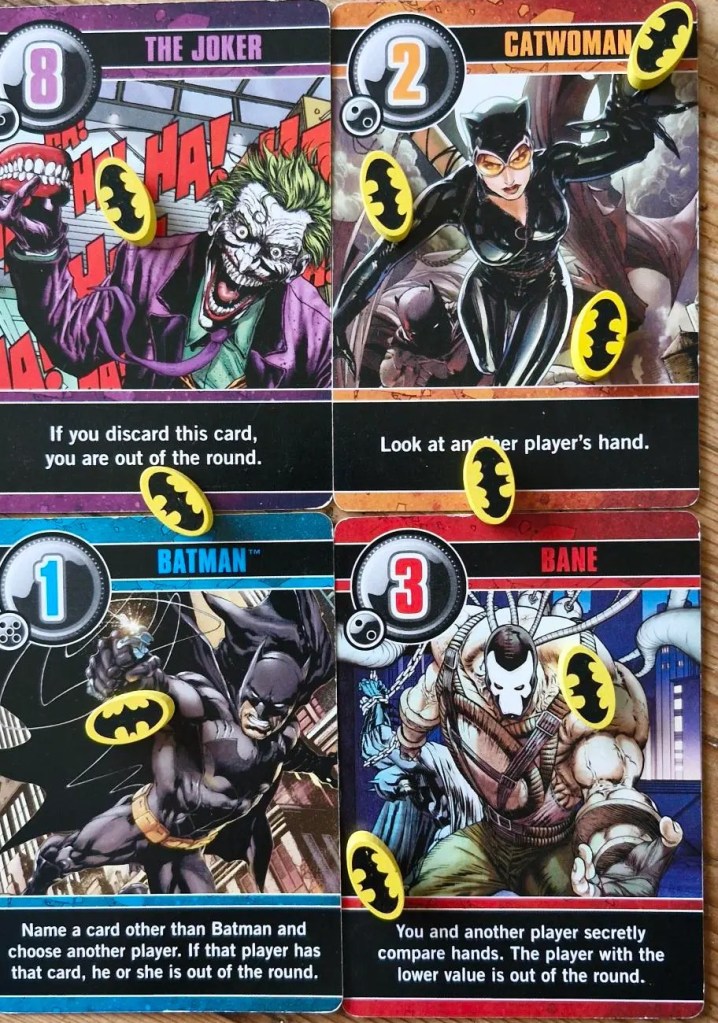
As you can see I am rather fond of this little game, it’s held a place in my collection for several years and has often seen the table in one of its various guises. Wait, different versions? Indeed, the simple core structure has resulted in numerous alternate versions, such as, Batman which is very much a pure reskin with various characters like Poison Ivy and Robin replacing the classic fairy tale-esque people from the original. However, there’s also an Archer version based on the animated series which although plays in very much the same way does add in a few subtle touches that just change up the play a bit.
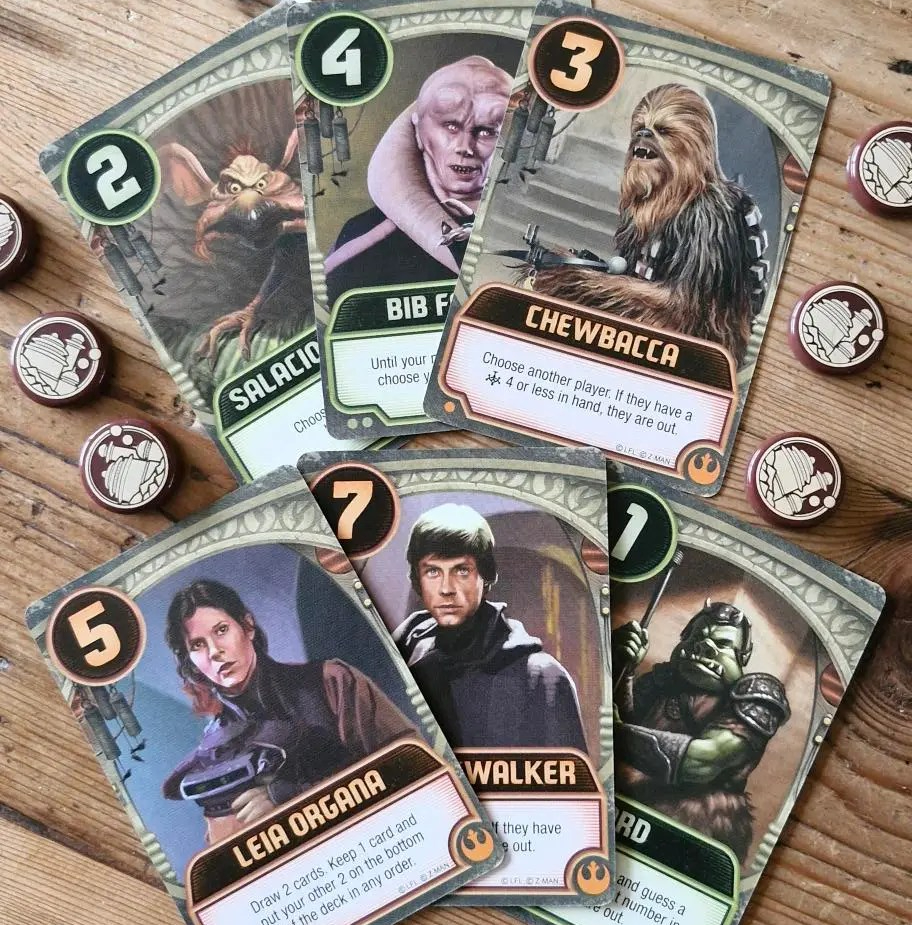
There’s the inevitable Star Wars version entitled Jabba’s Palace that goes slightly further than the Archer version in adding extra mechanisms, including extra winning conditions and cards that show either a rebel or palace member logo that are used with particular character abilities. We then have a Cthulu themed edition which bolts on quite a bit more and feels probably the most removed edition from the core version. The thematic issues I have with the very standard first edition are somewhat addressed with other versions like Batman as it makes sense why you would eliminate the highest value card being the Joker instead of the Princess from the original.
As a group we enjoy and do play all variants but generally stick to the lightest being the original and Batman versions. To sum up I feel that every gamer should not only try Love Letter but just give it enough time to present some interesting situations to you. I fully appreciate that there’s people who still wont enjoy what it offers and that is fine. It’s certainly not the sort of game that you invite people around to play specifically, but sometimes, presenting that little red bag to people when they don’t expect it, going on a surprise jaunt with that small deck of cards can really bring some fun and happiness, a bit like receiving an unexpected love letter.
 Cardbaudit
Leave a comment