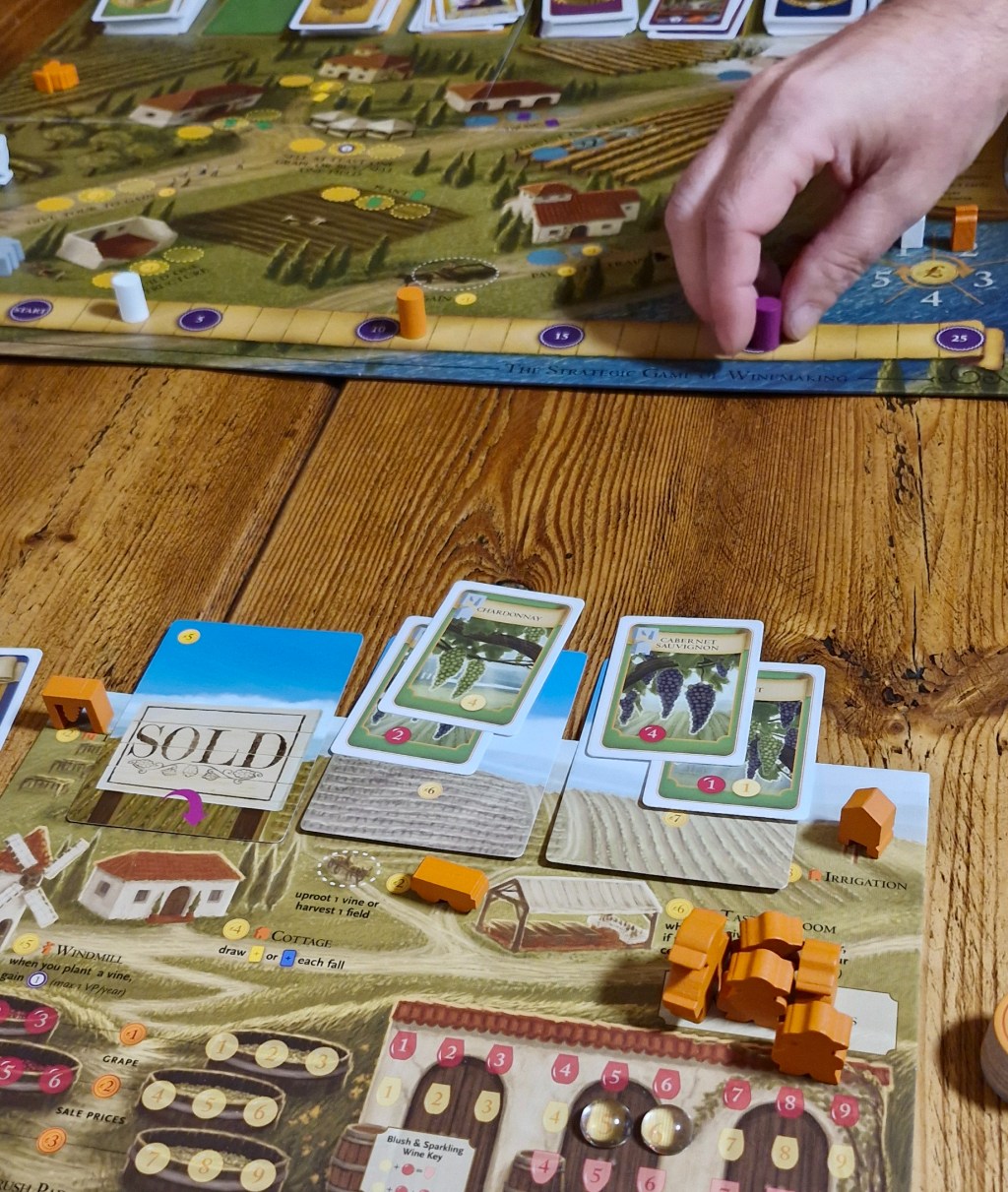
The rather sophisticated looking Viticulture has garnered a lot of praise over the years, often being listed in people’s top however many games lists. Due to the status of this game I felt a copy of it should be added to my cellar, however, much like a distinguished bottle of wine it has sat there gathering dust and ageing for quite a while. So the time felt right to pop the cork on this one, let it breathe and then swirl it around and see what the fuss is about. So here are my thoughts after just one play(glass).
Straight away just from looking at the box and the subject matter this feels like its meant to be a grown ups game. Not just in the fact it’s about wine but the art style, the quality of the components and the way they fit into the box in neat trays, the quality of the manual and numerous other touches. Thematically it would almost be better placed alongside our cookery books instead of sitting next to Quacks of Quedlinburg and Galaxy Trucker. It looks like a connoisseur of classical music being forced to share a table with two stoned ravers at Mcdonalds.
Learning the game I wasn’t completely cold going in, it’s well known this is a solid worker placement game. A genre regarded rather fondly within our gaming group, with titles like A Feast for Odin, Agricola and Pipeline some of our favourites. So how would this compare? Well from doing a learning session and quick couple of turns to effectively rehearse the teach it became apparent that Viticulture was probably a bit lighter than those aforementioned games. Difficult to target in on exactly why but immediate direct thoughts were less options than Odin and it didn’t seem that you’d be as punished for mistakes as you would in Pipeline.
All of those games certainly seemed to focus around a core system to nudge and work, with spaces to enhance the productivity of that central element. I suppose this is standard worker placement design. Viticulture’s example of this is certainly very pleasing with a three stage process of planting vines, harvesting the grapes and then converting them into wine. It’s not quite a brain burning as Pipeline’s system of building a pipe network to process oil but it does certainly require some degree of forward thinking. It is also similar to Pipeline in that you’re ultimately working towards fulfilling orders/contracts but you can sell off resources (grapes or oil depending which game you’re playing) before converting them to get money. So it has that very pleasing dilemma.
So onto our first game, played at three player count. Picked up quickly and everyone was displaying their thinking faces after just a couple of turns. System and structure wise it all felt very familiar to us being quite seasoned gamers, this is certainly not a negative comment. From the three of us we did all play out quite different strategies. For me I focused on picking up several contracts and working towards them, while the others were slightly more focused on gathering visitor cards. It became apparent that drawing decent visitor cards could have a very big impact in terms of victory points. The final scores were pretty close but it had a similar pattern scoring wise to Splendor of all games. You either chip away picking up points here and there slowly working towards the line of you build up for sudden surge. It certainly demands some further play and probably a revisit in perhaps five games to really try and draw some conclusions. Certainly though after a single play we could see why this is such a popular game. We’ll be back after we finish a bottle or two…
 Cardbaudit
Leave a comment