There’s no shortage of good small box card games circulating around this hobby and for people like myself it can be hard not to add just one more of them to the shelf. They seem to be a really easy purchase, not just for the fact they are generally on the cheaper side but because the commitment with them is easy to fulfil. They often have a fairly short set up, teach and play time meaning you can complete the satisfying full journey of a game including post game discussion in a relatively short timespan.
This is very much the case here with Faraway, not only in that you’ll complete the game cycle journey in quick time but that in the game itself you’ll be going on a journey, thematically that is, not literally! You’d think that going on a journey far away you’d need to pack lots, however, looking at the contents of this box it’s just two decks of cards and a scoring pad. It’s svelte, this thing travels light.
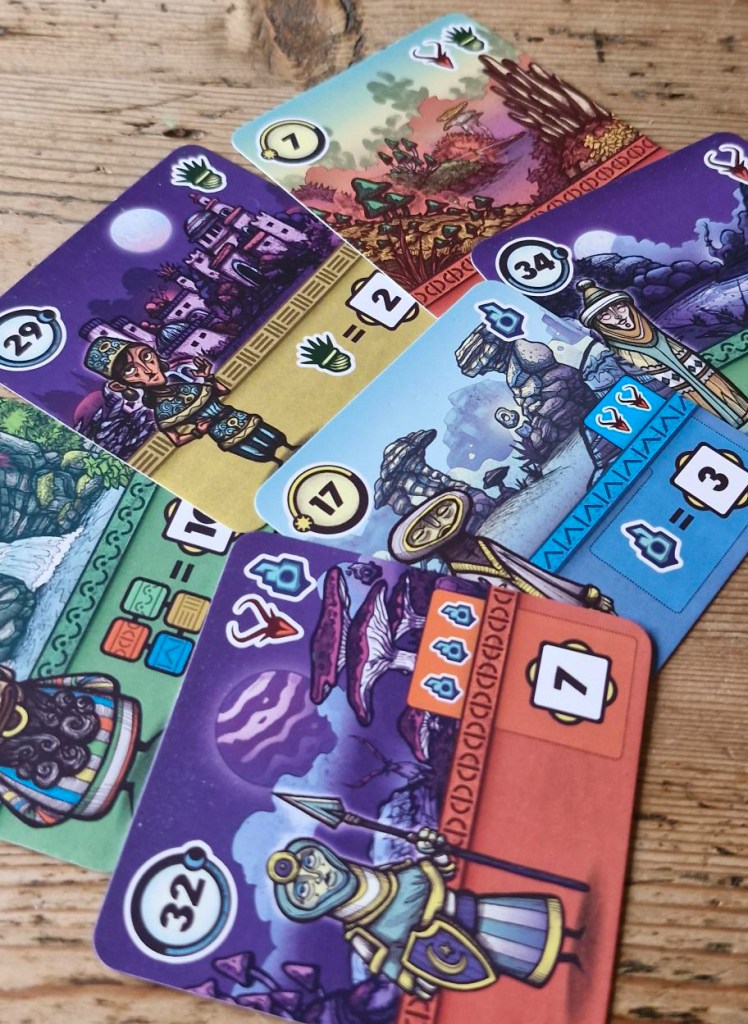
Set up is so simple, you shuffle the two decks of cards and from the main deck you deal each player three cards, then put out a number of cards face up in the middle of the table, dependant on player count. The secondary deck which contains what is known as sanctuary cards is just put face down in convenient reach of all players. That’s it, you are good to go, bon voyage!
Having taught the game to several people it’s interesting that every time the teach is pretty swift but trying to add too many examples of the cards and combinations can bog it down. Generally speaking the best way to learn is know the basic structure of gameplay and then play the first game badly. The mistakes and realisations that dawn on you teach the game far better than being waffled at. Learn how a turn works and just dive in, it comes together so quickly.
For the purposes of this review though we will outline proceedings. The game consists of eight rounds, with turns taken simultaneously which certainly drives game time down. In each round players secretly select one card from their hand, then all cards are revealed simultaneously and placed forming a row in front of each player. Part of each cards’ anatomy contains a numerical value which defines the order in which players then draw a new card from a selection available in the centre of the table which they add to their hand. This process is repeated until players have eight cards in a row in front of them, at which point you move to scoring.
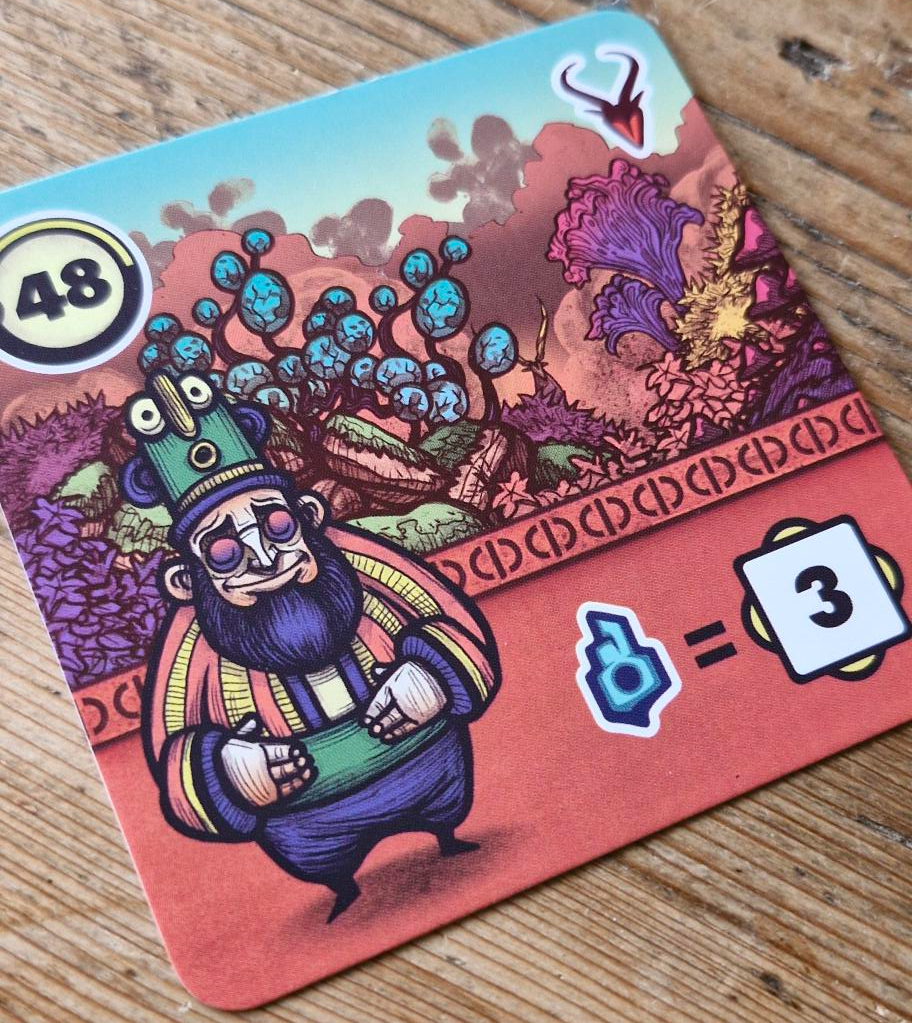
Before we look at scoring we’ll just explain a bit more about the cards from the main deck and also the aforementioned sanctuary deck. Each of the cards from the main deck fall into one of four different colour categories, blue, red, yellow and green. The vast majority of the cards will offer a particular way of scoring points, usually based around colours of card or symbols on display in your tableau. Lots of the cards will also display one or two symbols from a selection of three and often these symbols are required to activate the scoring criteria on other cards.

We mentioned briefly before that each card has a numeric value dictating the order in which players draft new cards for their hand. Well should a player present a card with a higher initiative than the one previously played they get to take cards from the sanctuary deck. These sanctuary cards will offer players additions to their scoring flexibility with extra symbols on display, colours available and also extra scoring criteria. This adds a pleasant extra layer of consideration to proceedings as you have to weigh up playing low numbers to get first pick of new cards against playing higher values to pick up sanctuary cards.
You’d be right in thinking that the whole tableau building and needing certain symbols or resources to unlock and score a card doesn’t feel new as such, nor does balancing the low or high initiative to determine the order of the draft against other bonuses but combining this with the reverse scoring really makes for a very neat very thinky game. So let’s look at this reverse scoring.
When the game ends and scoring begins this rather special aspect arrives and you realise you had your brain in the wrong way round. The first seven cards each player has played are all turned face down and then players score the cards they’ve played in the reverse order with which they were placed. Why is this an issue? I hear you ask. Well most of the cards will contain points players might score by playing them, note the use of might. Cards will often have a series of symbols on them required to be visible in that players tableau in order to effectively unlock the score. However, if those symbols are on cards which are currently face down then they’re obviously not available. This is where you realise the order in which you played your cards becomes so very important, you need to plan and think in reverse.
Some cards will offer a big return in points but often require three or four symbols in order to be active, so these cards need to be placed first and the cards offering those symbols after so that as you travel back down the line of cards all the ones you need to score the big points are already turned over. Something else that can come into play is the beloved hate drafting, as committing to a certain card that offers big points also signals to other players what you’re after.
So then comes the consideration of do you play low cards to get first pick from the middle but then potentially miss out on sanctuary cards, which can be so useful as they do not get turned face down and their bonus is ever present. However, sanctuary cards are drawn face down so it’s luck of the draw. Aggghhhh it’s a painful delight, it’s got terrific layers of consideration but it’s never stodgy, you don’t feel bogged down as the game is so short you can make decisions and know they’re not going to haunt you for forty minutes.
The short playtime for this game has meant every time I’ve played a game there’s been a request to play a second and third time. It seems to promote a desire to achieve an almost perfect tableau where players can score from every card, which, spoiler alert doesn’t really ever happen. You have to accept that often you are simply putting a card down purely for the benefit of scoring another, the perfect combination will not happen. This isn’t a bad thing at all as it creates an addiction to trying.
The concept of going on a journey meeting different characters at each step to establish what they need you to essentially bring back is a very nice idea and does fit the mechanics, however after a few plays you forget that’s what is meant to be happening and you’re just focusing on the symbols on the cards. That said it’s far more pleasant to play with cards containing artwork, which we must say is of a very good standard than plain cards and symbols devoid of any theme. It gives the game charm and warmth, a personality really.
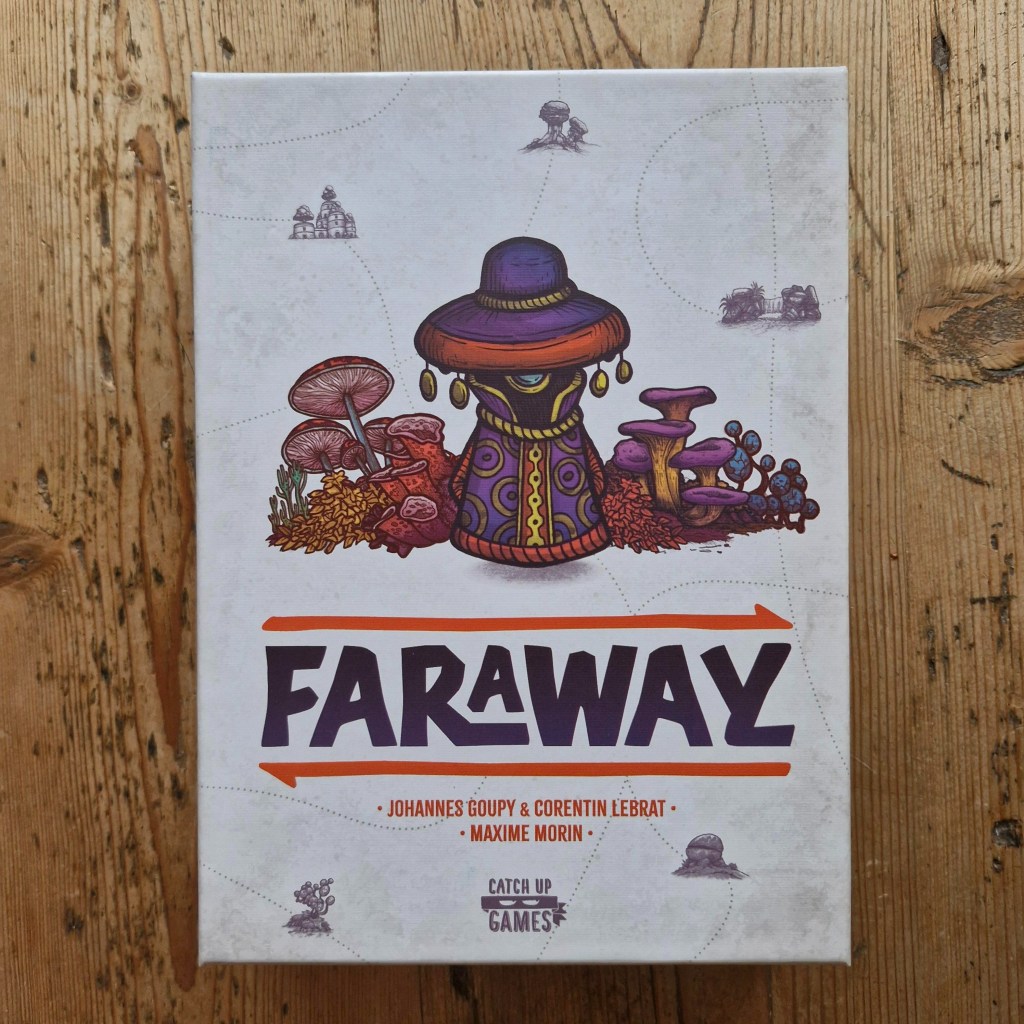
There is news of an upcoming expansion which is certainly interesting and pleasingly it looks to be in the form of what is essentially a booster pack of cards. Those of which can simply be shuffled straight into the main and sanctuary decks and be utilised without any extra disruption to the base game. Bloating this product with too many extra rules would be a bad move in our opinion.
So there we have it, in conclusion Faraway is a solid well considered thinky card game offering interesting decisions and a real arc in what is a pretty short timespan. Presentation is lovely and the components great quality. This game deserves a place in any collection, very easy recommendation.
 Cardbaudit
Leave a comment