
There are three games in my collection that evoke the same feeling, the one where what you decide to do on your turn really matters and if you make a poor decision you damn well feel it for the rest of the game. That’s not to say that in every other game your turn simply doesn’t matter, that would be ridiculous, what we’re saying is that in Pipeline, Calico and the game in question here Castle Combo, your turn decision REALLY matters.
From the outside Castle Combo looks like a fun snappy card game with jolly artwork of knights, jesters and bombardiers where you breezily take cards from the centre of the table, adding them to your display almost like you’re collecting medieval football stickers. Trust me this is not the case, a few turns into the game you’ll feel like you’re trying to do a cartwheel in a phone box.
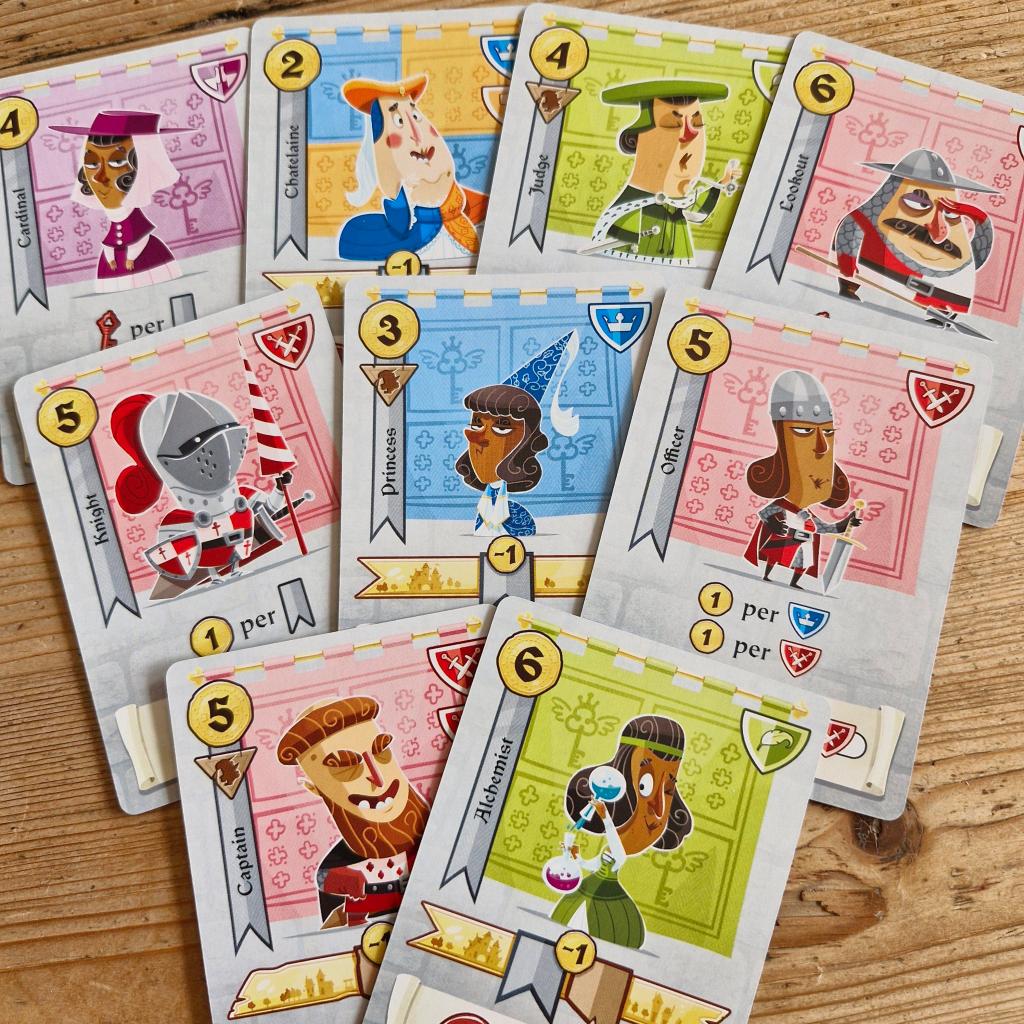
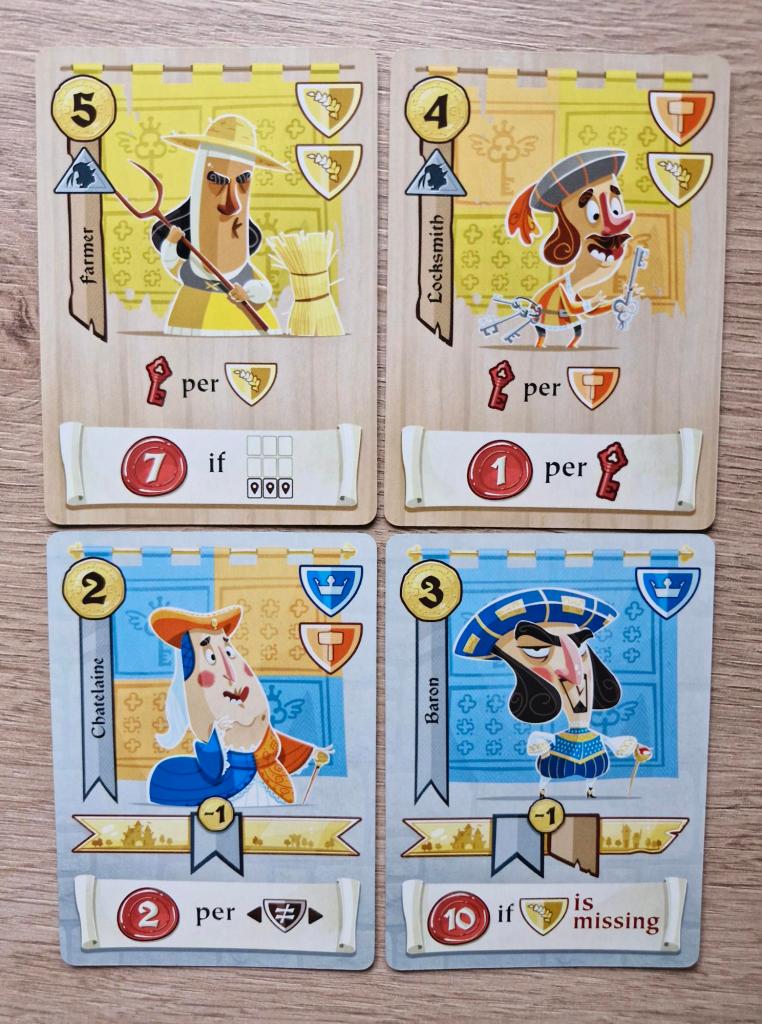
So let’s summarise exactly what is going on here. Castle Combo is a tableau builder, you’ll be purchasing cards from a display in the middle of the table and creating a three by three grid of those cards in front of you. The trickiness of the purchasing decision in this game is actually two layered as the card you choose will give you some sort of instant reward like more money or keys, more on keys later, but will also have an end of game scoring opportunity often dependant on the placement of the card itself and those around it. Additionally each card will have symbols on it in the form of coloured shields that tie into end of game scoring but also can help to enhance the instant reward from other cards taken.
Herein lies the problem, you’re trying to make sure you maximise the potential each card you place but you’re just so restricted with space. Given you’re creating a three by three grid each player will have nine turns in the entire game and every turn has multiple considerations with you doing quite simple but rapid maths trying to establish the possible output from the options both now and at game end.
The arc of this game is so similar to Calico, you start off with an empty grid which feels nice and open and you can just place your first card without too much worry as you don’t have to declare what space that card is in but all other cards have to then be orthogonally adjacent to a previous card, so suddenly after a few turns your grid snaps into a fixed position and now you only have five spaces left and those decisions are restricted and deeply considered.
Let’s go back to those keys we mentioned as they offer you some welcomed flexibility with purchasing cards. Your choice of card is taken from two rows each containing three cards drawn from a separate deck, one being the village and the other being the castle deck. The rows are also home to a messenger pawn that resides beside one row at the start of your turn and dictates the row you may purchase from. However, on your turn you may spend one and only one key to either wipe out and redraw the cards in that particular row should you not fancy any of them or move the messenger to the other row allowing you to purchase from that row instead. Also, keys are worth points at game end, so maybe don’t go throwing keys away without much consideration.
Should you be in a position where even after spending a key you don’t want to or cannot for monetary reasons purchase a card, you may take any card in your row for free and place it face down in a spot on your grid instead. This option will negate everything on the front the card and simply gift you six coins and two keys, which does sound quite good and can get you out of a financial pickle but it does mean one of your nine available spaces is effectively null at the end of the game in terms of offering victory points, so like all the other decisions in this game it shouldn’t be taken lightly.
So what about strategies and the best approach to this game, can you become good at it? Well a lot will depend on which cards happen to emerge at the right time for a particular player and if purchased will slot beautifully into their grid, firing off against all the cards that happen to be around it, belching up a swathe of victory points. That is not to say in any way that Castle Combo is just luck of the draw, far from it. A lot like Calico you will structure your tableau and leave gaps to be flexible. Sometimes things work out and sometimes they don’t. Generally speaking though the person who wins will have played the game well and repeated plays will like a lot of games show what some of the more lucrative point scoring avenues are.

You’ve probably guessed that there isn’t really any player interaction as such. Nothing you do will negatively impact your opponents apart from deliberately taking a card you know they’d want, but given you have so few turns and spaces to play with taking a card you don’t really want to stop someone else getting it will generally do more to negatively impact your own score than trash theirs. Part of my mind has wondered if there could’ve been cards with actions that directly impacted another player, like forcing them to turn a card over or move a card but on reflection I think this would be far too infuriating and generally speaking this experience is perfect as it is.
With that we’ve pretty much covered Castle Combo, a simple snappy yet thinky game which fits into just half an hour or thereabouts, after which you’ll very much feel like you’ve taken more than just nine turns, this thing feels wholesome and you mind will feel more like you’ve been playing some sort of mid weight game. There are other elements to some of the cards that will for example allow you stash coins on them for points and others that will provide discounts on further purchases but we wont spoil too much more and you should find out these things for yourself.
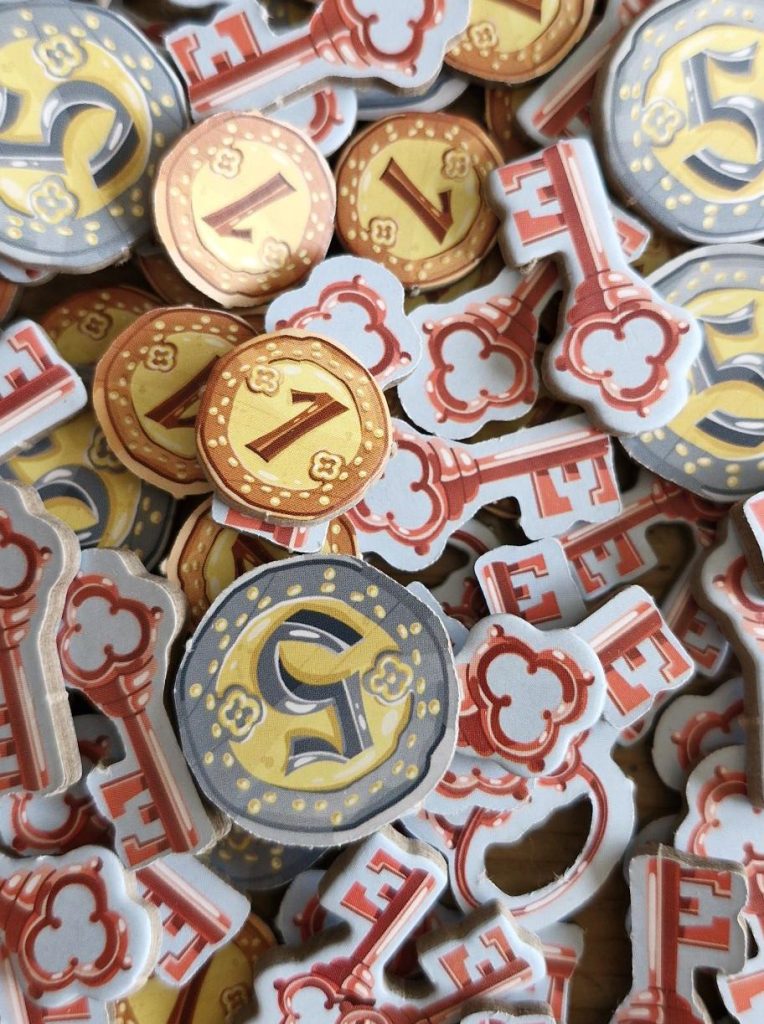
The production quality is great with lovely thick card coins and keys and the instruction manual is nice and concise with good gameplay examples. The artwork is bright, humorous and beautifully illustrated which will appeal to many people, however my own personal taste would prefer it to be more akin to the darker grittier artwork of something like Citadels. Please though do not let that come across as a negative as Stéphane Escapa really has done a Stella job here. There we have it, much like you’ll study your tableau in this game have a good look at your game shelves as there is defiantly the perfect spot there for a copy of Castle Combo.
 Cardbaudit
Leave a comment