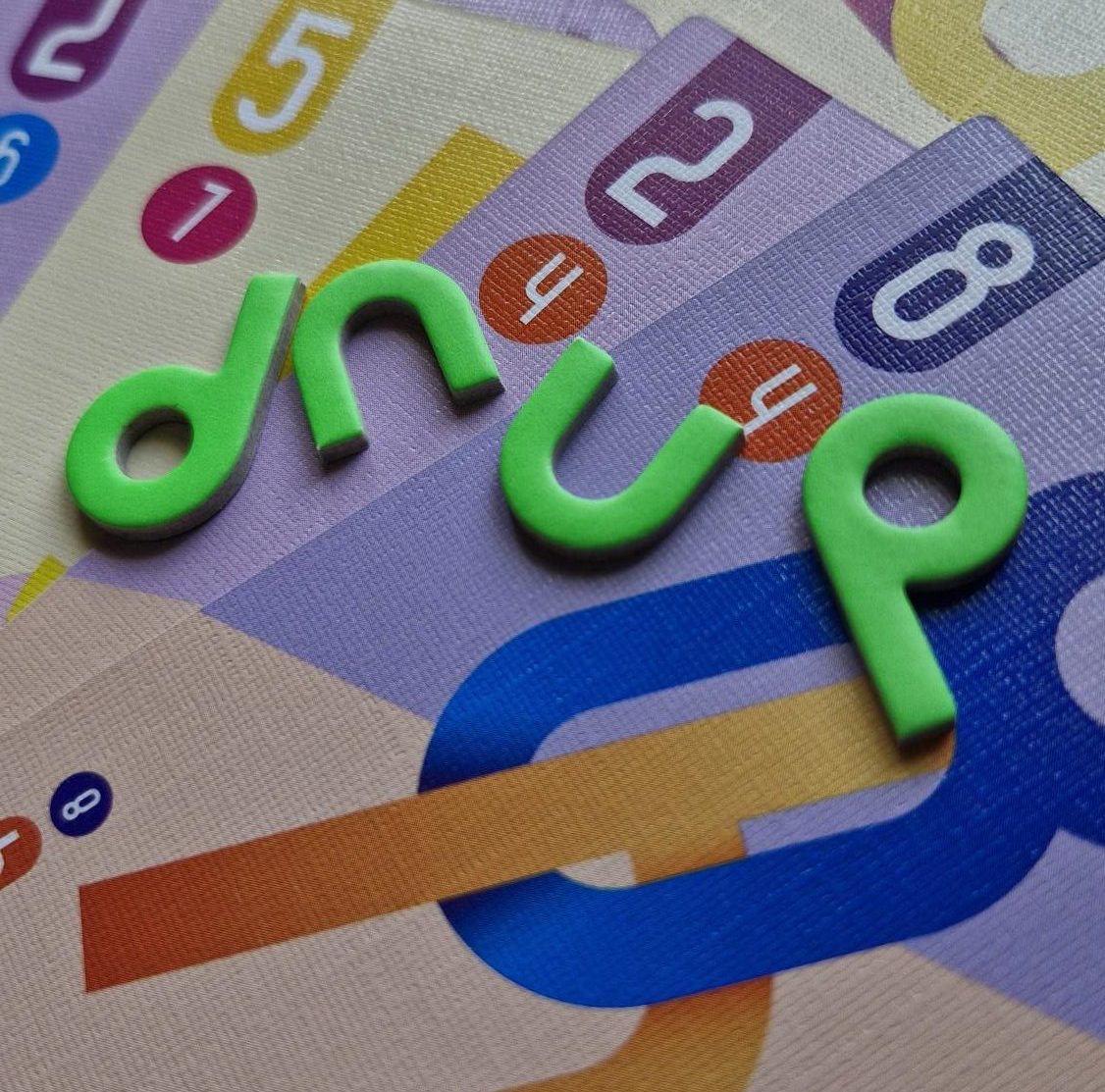
Sometimes a flavour variant of your favourite fizzy drink comes along with an interesting little twist. One that you’re not entirely sure you’ll like but entices you enough to think you might as well try it anyway. dnup appeared on most people’s radars in the lead up to UKGE 2026, with many previews stating it was similar to the ever popular fizzy card game Scout, also from the same designer Kei Kajino. This lead to people wondering if they actually needed another card game like Scout, and then thinking they may as well have a look as they might like it.
So just how similar are we talking? Well, both games are card shedding where you’ll be playing sets of cards to the table, which can then be bettered by other players and the cards themselves are flipped at various points in the game to change their value. You can see why people have drawn the comparison to Scout but is dnup enough of its’ own game and is it worth having both games in the small box section of your collection?
Let’s have a look at the various aspects of dnup and then consider the Scout battle. Setup is very simple, just a case of shuffling the deck adjusted to player count and dealing every card out. There are scoring tokens in the box and they’re just set off in a convenient space. Your turn consists of taking one of four possible actions, which consists of two predominantly taken actions and two others for when you’re in a pickle.

The main action you’ll be utilising is playing sets of cards to the table. These can be any number of cards but the cards have to be the same number. Other players can play sets which could then beat yours but they must be the same number of cards and of a higher value. So if you have three 2s down and someone plays three 4s that has beaten your played set and as a result you must then return your played set to your hand, with the added twist that they are rotated upon returning so their individual values are then different.
If you had your three 2s down and someone played two 8s for example then nothing would happen as there’s only ever a challenge if the number of cards is the same. If play goes around the table and nobody has bettered your set then those cards are simply put in the discard pile before you commence your next turn.
The action that generally gets utilised almost as much is being able to add a single card from your hand to another players set already on the table. This doesn’t sound that interesting but it’s probably the most fun mechanism. Utilising this action not only means you can get rid of a card without the risk of having to pick it back up before your next turn, it also allows you to trigger a challenge between two other players. If there was a two card set on the table and three card set , being able to potentially add a card to the two card set means there’s now multiple three card sets and as such the lower value one will have to be picked up by its’ owner! Mwahahaha lovely stuff!
The other two actions are used much less and simply consist of being able to pick up a whole set from in front of another player, rotating the cards and adding them to your hand and final action is you can simply rotate your entire hand. These last two actions have really only been used when a particular player simply cannot play a set or add a card to another set, it’s not often been the case where someone decides to pick up cards instead of playing a set.
Round end occurs after a second player empties their hand with the first player scoring two points and second place one point. After this you start a fresh round and it’s the first player to score four points in total. Simple as that!

So all the usual questions then, firstly is it a good game? This will very much depend on what individuals are hoping to get out of it, but if that is a quick amusing slightly mean experience then this fits the bill perfectly. If people are after a highly thinky game with strategic considerations then probably not. You would hope the look and name of the game might give people some clues towards these sort of expectations!
What is the teach like? Simple enough, most people are familiar with the concept of card shedding even if from classic card games played with a standard 52 card deck. The general flow of how one set beats another and picking cards back up transfers best by just playing a few demo rounds and people generally go ‘oh ok’ after a couple of mins.
How’s the quality of the components? Artwork is fine, the box is very bright and stands out a mile, sensibly sized too which is always good. Do quite like that no theme has been force fed into the game, always felt the theme in the latest version of Scout was perhaps a little pointless and when I’ve taught people to play Scout I’ve never actually started by saying ‘in this game you’re running a circus looking for performers to join your show’, it’s always just been an explanation of how you get rid of your cards. Price point is good too, around the £12 mark so comes in slightly cheaper than you’d often find Oink titles.

Final thoughts then with regards to the Scout comparison and is there room for both in your collection. If you’re a huge fan of the Scout system then I’d probably say it’s worth grabbing a copy of dnup given the very cheap price point as it’s nice to have both games there to play depending on your mood. If you don’t have either game and quite like the sound of this double ended card flipping and shedding vibe, then I’d probably go for dnup. It’s cheaper and slightly more fun and accessible. Scout is still great though, damn it just buy both!!
Official website – https://www.dnup.game/en/
Leave a Reply